Hardee’s®
- 4.6
- Rating
- 1.00M
- Installs
- Free
- Price

 Analysis by App-foxy
When I order from a restaurant app, I care about a practical detail before anything else: will it help me make a decision and place an order while my connection is behaving normally, without making a small network hiccup turn into a bigger hassle? With Hardee’s®, the answer depends partly on how settled my plan is. The app is useful when I already know I want food from the chain and can take a moment to browse and check my choices. I would be more cautious about relying on it at the last second, especially when I am rushing or my mobile signal is unreliable.
Why a steady connection matters
A mobile order is a chain of small steps: opening the app, choosing what sounds good, selecting the restaurant, reviewing the basket, and completing the order. I find that this works best when I have enough time and a dependable connection to move through those decisions without rushing. It is less appealing if I am trying to make every choice while walking into the restaurant or juggling other tasks.
That is not unique to Hardee’s, but it shapes how I would use this particular app. I treat the phone as a place to prepare the order, not as something I want to troubleshoot while a queue forms behind me. If service is poor, I would rather pause somewhere with a better connection or order directly at the counter than assume the app has completed a step I have not seen confirmed.
You May Also Like

 Blood Strike: 2.5 Anniversary
Blood Strike’s Loadouts Turn Every Drop Into a Tactical Gamble
A close look at Blood Strike’s custom loadouts: how fast access to signature weapons reshapes its battle royale rhythm, rewards preparation, and narrows the gap between fights.

 Pandora - Music & Podcasts
Pandora’s Music Is Easy to Start, but Harder to Recover
Pandora’s strength is its low-effort path from a seed to a station. Its weak spot is how much confidence it asks you to place in connection, setup, and quiet recovery.

 8 Ball Pool
 Is Built on Rivalries, Rematches, and Routine
A close look at the rivalries, rematches, shared routines, and unanswered safety questions that turn a quick pool match into a persistent mobile community.

 Samsung Music
’s Quiet Strength Is Playing What You Already Own
Its reach comes less from spectacle than from dependable access to a personal library. That simplicity is both the app’s strongest retention engine and its ceiling.

 AccuWeather: Weather Radar
AccuWeather Review: A Quick, Clear Forecast for Everyday Decisions
For everyday plans, the best forecast is the one you can understand quickly. AccuWeather makes rain timing, radar, and local conditions easy to act on, with a few trade-offs.

 Hill Climb Racing
Why Hill Climb Racing Still Turns Crashes Into One More Run
A tiny car, a bumpy hill and one more upgrade: Hill Climb Racing keeps resurfacing because its simple chaos makes every near-miss feel personal.
More From Our News Desk



A better fit for planned stops than split-second choices
I would use it before a commute, during a lunch break, or while organizing a meal for other people, when there is time to inspect the menu and basket. For a spontaneous stop, I would first ask myself whether opening an app is actually easier than speaking to the staff. That quick comparison prevents the phone from adding work to a visit that could have been simple.
For a family or office order, the extra review time can be worthwhile because each person may want something different. I would gather everyone’s choices first, then enter them when I can pay attention. It is a small workflow change, but it reduces the chance that I am trying to remember someone’s request at the same time as dealing with a slow connection.
Mobile ordering is the feature that matters most
I find mobile ordering most useful when it gives me room to think before I reach the counter, rather than asking me to make rushed choices on the spot. In this section, I look at how browsing and checking a basket can help with familiar meals and group orders, while keeping in mind that the app still depends on a smooth, attentive process.
A calmer way to choose a Hardee’s meal
The main capability is not complicated, but it changes the rhythm of a fast-food visit. Instead of arriving at the restaurant and immediately deciding what to say, I can browse first. That is especially handy when I am ordering for someone else, comparing a burger with a chicken option, or trying to include breakfast or dessert without forgetting anything.
I like this approach more than using a generic delivery marketplace when I plan to pick up the food myself. A marketplace is useful when I want to compare several restaurants, but it also adds distractions: unrelated menus, delivery choices, and competing fees or timings. Hardee’s keeps the decision inside one restaurant’s menu, so the path from craving to order is shorter.
There is also a practical benefit for people who dislike making quick decisions aloud. I can review the menu privately, think about substitutions or extras where available, and confirm the basket before I place it. That small pause is valuable. It reduces the chance of ordering the first familiar item simply because a line is waiting behind me.
What the app is best at
In my experience, the app makes the most sense for repeat customers. If I already know the kind of meal I want, mobile ordering turns the visit into a preparation step followed by collection. It is less about discovering a hidden culinary experience and more about making a familiar fast-food routine less awkward.
The range described by the app covers the parts of the menu people commonly visit Hardee’s for: burgers, chicken, breakfast, and desserts. That breadth is useful for households with different preferences. One person can choose a burger, another can choose chicken, and someone else can add a sweet item without everyone having to negotiate at the counter.
One non-obvious advantage is how the app can help with timing. I can build an order before leaving home, review it while I still have a clear head, and then use the restaurant visit as the final step. This is more useful than it sounds during a rushed morning or a short lunch break. It does not eliminate every delay, but it moves some of the decision-making away from the busiest moment.
Using it without turning the order into a mistake
I recommend treating the basket as a checklist rather than assuming the first selection is correct. Before confirming, I would look at the main item, the side or accompanying choice, the drink if included, and any dessert or extra added for another person. This is particularly important for group orders, where a small omission can mean another trip to the counter.
I would also read the selected restaurant and collection details carefully before placing the order. A mobile order is only helpful if it is attached to the location where I actually intend to eat. When I am travelling or ordering from an unfamiliar area, I would take an extra moment to verify that choice instead of relying on memory.
Another useful habit is to prepare the order before reaching the restaurant, but not so early that plans are likely to change. If I am still deciding whether I will eat at home, at work, or on the road, I would wait. The app is strongest when I have a reasonably firm plan and want to make that plan more efficient.
A realistic weekday example
Imagine a busy weekday morning when I am leaving for work and want breakfast from Hardee’s. At the counter, I might be distracted by the clock, other customers, and the need to remember what a colleague asked me to bring. With the app, I can make the selections before leaving, check the order once, and arrive with a specific collection task rather than an open-ended menu decision.
The same workflow works for lunch, but with a different advantage. If several people in an office want different meals, I can assemble the order while everyone is still deciding, then review the complete basket before submitting it. The app does not solve every group-order problem—people can still change their minds—but it gives me a visible place to check the details instead of relying on a handwritten note or a hurried conversation.
For an evening visit, dessert becomes easier to remember because it can be considered alongside the main meal. That is a small design benefit, yet it shows why a dedicated restaurant app can be more useful than simply walking in: I can think through the whole order rather than stopping at the first item that comes to mind.
Where the experience can feel less convenient
The trade-off is that mobile ordering adds a digital step. I have to open the app, select the restaurant, browse the menu, and confirm the order. For a very simple visit with no queue, walking to the counter may actually be faster. If I am already standing inside and know exactly what I want, the app may feel like unnecessary preparation.
It also asks me to be more attentive. At a counter, I can immediately ask a staff member to clarify something. In an app, I need to understand the choices presented on screen and notice whether my basket reflects what I intended. That is not a serious flaw, but it means the convenience comes from careful review, not from blindly tapping through the menu.
Another limitation is that the app is not the best tool for comparing restaurants across an entire area. A delivery marketplace or map-based search is better when my first question is “What should I eat nearby?” Hardee’s is better when the first question is “How can I order Hardee’s with less friction?” Those are different jobs, and choosing the right tool makes a noticeable difference.
Who should use it and who should skip it
I would recommend it to regular Hardee’s customers, commuters, parents ordering several different meals, and anyone who prefers to make food decisions away from a crowded counter. It is also a sensible choice for people who value a dedicated menu experience over browsing a large delivery platform.
I would be less enthusiastic for someone who rarely visits Hardee’s and mainly wants to compare nearby restaurants, delivery options, or cuisines. That person may get more value from a broader food-ordering service. I would also skip the app for a spontaneous stop where I am already inside, the restaurant is quiet, and my order is simple enough to say immediately.
People who need a highly conversational ordering experience should keep their expectations realistic. The app is designed to let me make selections, not to replace a staff member’s ability to discuss every possibility. When I have an unusual request or need personal clarification, ordering directly may be the more comfortable route.
What to do when a connection falters
If a screen stalls or the connection drops while I am putting an order together, I would avoid tapping repeatedly or starting over immediately. First, I would give the app a moment to respond and check what is still visible. If I cannot tell whether the order was completed, I would verify its status before trying again; submitting a second order without checking could create confusion rather than save time.
For a meal with a firm deadline, I would keep a simple fallback in mind: finish the order at the restaurant if the app is not cooperating. That is especially sensible when I am already nearby. A dedicated ordering app is a convenience, not a reason to let a network problem dictate whether I can eat.
What the current release tells me
The current version is 5.2.0, and the app requires at least operating system version 10. That makes checking device compatibility worthwhile before planning to depend on it during a trip. On a supported phone, the experience is aimed at a simple task rather than a complicated account-management system, which helps keep the purpose clear.
Because it is free, there is little downside to trying it if Hardee’s is already part of my routine. The real cost is not the download; it is the extra attention needed to confirm the restaurant and order details. I see that as a reasonable exchange when the visit is planned, but not as an automatic improvement for every possible meal.
How I would keep the process data-conscious
For anyone mindful of mobile data, I would do the browsing and basket review while connected to a trusted Wi-Fi network when that is convenient, then avoid leaving the app open longer than needed. I would not assume that the menu or an unfinished order will remain available without a connection, so I would complete the important decisions while the network is steady rather than depending on an offline state.
There is a practical privacy habit here too: I would use the app when I am comfortable handling the order on my own phone, and keep the screen private when entering details in a crowded place. The useful point is not to overcomplicate a quick food purchase, but to remember that a mobile order involves both a live connection and attention to what is on screen.
My final take on the ordering workflow
Hardee’s succeeds when I use it as a planning tool. Its value comes from taking the menu decision out of the busiest part of the restaurant visit and giving me a chance to assemble burgers, chicken, breakfast, or desserts at my own pace. That is a focused benefit, and the app does not need a long list of unrelated features to justify itself.
My strongest tip is to use it before leaving, especially for a group or a time-sensitive meal, and then review the complete basket before confirming. That workflow captures the real advantage: fewer rushed choices and a clearer handoff when I arrive. For a quiet, unplanned stop, the counter may still win on speed.
Overall, I think this is a worthwhile free app for people who already choose Hardee’s and want a more deliberate way to order. It is not a universal replacement for restaurant search or face-to-face ordering, but it is a practical dedicated option. If your goal is to make a planned Hardee’s visit smoother rather than discover every food option around you, this is the kind of app I would recommend keeping installed.
CKE Restaurants has kept the purpose easy to understand, and the strong user response reflects that clarity. With its Everyone age rating and broad menu focus, Hardee’s® is approachable for families, commuters, and repeat customers alike. I would use Hardee’s® when I know where I want to eat and want control over the ordering process; when I am still deciding where to eat, I would choose a broader alternative instead.
My connectivity verdict
For me, the app works best when a planned Hardee’s visit and a stable connection meet: I can make choices without hurry, check the basket, and arrive with a clearer plan. If I am offline, facing a time-critical order, or unsure where I want to eat, I would choose the counter or a broader discovery option instead. Its 4.6 average from around twenty-two thousand ratings and more than a million installs point to a well-used service, but my recommendation is still conditional: use it as a focused ordering aid, not as a guarantee that every visit will be faster.
FAQs for Hardee’s®
01What is the Hardee’s® app used for?
The Hardee’s® app is designed to enhance your dining experience by offering a convenient platform to order food, customize your meals, and access exclusive deals. It allows you to locate nearby restaurants, view nutritional information, and save your favorite orders for quick access. The app is a must-have for frequent patrons.
02Is the Hardee’s® app free to download and use?
Yes, the Hardee’s® app is completely free to download and use on both Android and iOS devices. There are no hidden fees associated with using the app, and it provides access to a range of features, such as exclusive discounts, rewards, and a seamless ordering process.
03Can I earn rewards through the Hardee’s® app?
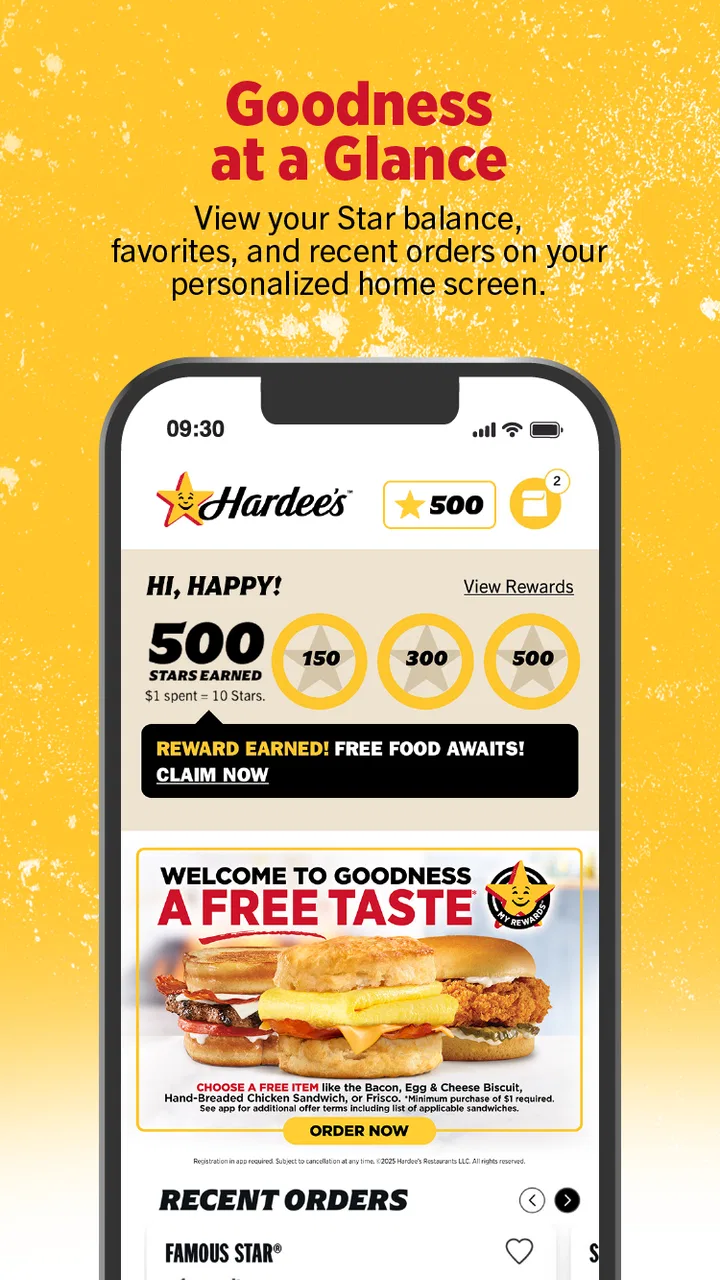
Absolutely! The Hardee’s® app features a reward system where you can earn points with every purchase. These points can be redeemed for free menu items or discounts on future orders. Be sure to check the app regularly for special promotions and bonus point opportunities.
04How secure is my personal information on the Hardee’s® app?
The Hardee’s® app prioritizes the security and privacy of your personal information. It employs encryption and secure payment gateways to protect your data. Additionally, the app adheres to strict privacy policies to ensure your information is handled responsibly. Always keep your app updated for the latest security features.
05Can I customize my orders using the Hardee’s® app?
Yes, the Hardee’s® app offers a flexible ordering experience that allows you to customize your meals to your liking. You can modify ingredients, choose specific add-ons, and tailor your order to meet dietary preferences or restrictions, all from the comfort of your mobile device.
Pros
- User-friendly interface with intuitive navigation.
- Wide variety of menu items to explore.
- Convenient online ordering and payment options.
- Frequent updates with new features and fixes.
- Easy access to deals and promotions.
Cons
- Limited customization options for orders.
- Occasional app crashes and slow performance.
- Requires a stable internet connection.
- Notifications can be overly frequent.
- Some features locked behind account creation.

Hardee’s®
Gallery